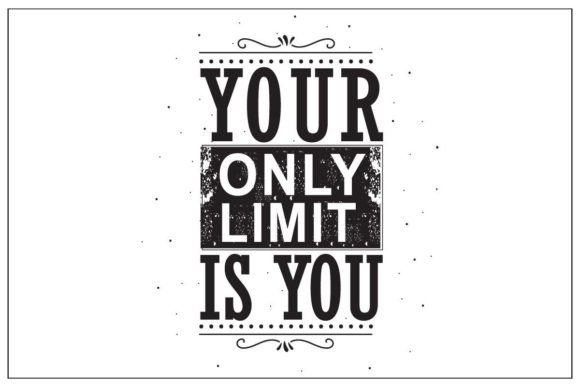
Your Only Limit is You SVG Graphics for Crafts
As a graphic designer who’s built brand identities for handmade businesses, launched print-on-demand collections, and crafted social media visuals for small business owners, I recently evaluated the Your Only Limit is You Quote SVG for a real client project: a spring wellness retreat brand launching limited-edition tote bags, digital workbooks, and Instagram campaign assets. My goal wasn’t just to see if it “looks nice”—but whether it functions as a reliable, versatile, and commercially sound graphic design asset in a professional workflow.
A First Impression That Lands with Intention
The Your Only Limit is You Quote SVG opens with confident, open-letter spacing and a balanced rhythm—neither overly ornate nor starkly minimal. It leans into modern design with subtle weight shifts and clean terminals, landing somewhere between contemporary sans serif and expressive display font. It doesn’t shout; it affirms. That tone is ideal for brands rooted in personal growth, creative entrepreneurship, or mindful living—think Etsy shops selling affirmation journals, yoga studios launching seasonal merch, or podcasters building printable wall art bundles.
Where This SVG Design Earns Its Place in Real Projects
In practice, the Your Only Limit is You Quote SVG shines brightest where emotional resonance meets visual clarity:
- T-shirt design and sublimation projects—especially on light cotton or heather grey—where its clean vector lines hold up flawlessly at scale;
- Product mockups for print-on-demand sellers needing polished, ready-to-upload assets for mugs, totes, and apparel listings;
- Social media graphics, particularly Instagram carousels and Pinterest pins, where its strong typographic presence draws attention without competing with photography;
- Cricut projects and vinyl cutting—thanks to the included DXF and SVG files, which import cleanly into Design Space with no path corruption;
- Printable design collections: when paired with coordinating line art or soft watercolor textures, it anchors motivational quote bundles for educators, coaches, and content creators;
- Packaging design for small-batch goods—used subtly on labels, belly bands, or thank-you cards to reinforce brand voice without overwhelming product hierarchy.
Where It Adds Quiet Authority—Not Clutter
This isn’t a background pattern or decorative flourish. It’s a statement piece. That means it works best when given breathing room: as a hero graphic on a landing page, centered on a poster, or scaled large across a notebook cover. In editorial design or blog visuals, it serves as a powerful pull-quote anchor—especially when layered over neutral gradients or soft-focus lifestyle imagery. For Canva template designers, it’s a high-value addition to empowerment-themed presentation decks or workshop workbooks.
Design Limitations You’ll Notice Immediately
Like any strong typographic asset, the Your Only Limit is You Quote SVG has boundaries—and respecting them keeps your client work professional. It loses impact below 24pt in print or on mobile screens; fine details blur, and letter spacing collapses visually. Avoid cramming it into crowded layouts (e.g., multi-line event flyers or dense packaging panels) where it competes with logos, icons, or body copy. On complex or busy backgrounds—like textured kraft paper or photographic collages—it needs solid color blocking or subtle drop shadows to maintain readability.
It’s also not suited for minimalist corporate branding, legal services, or finance-adjacent messaging. Its warmth and aspirational tone reads as personal, not institutional. If your client’s visual identity relies on strict grid systems, monochrome palettes, or ultra-thin typography, this SVG design may clash rather than complement.
What Every Designer Must Test Before Client Use
Before dropping the Your Only Limit is You Quote SVG into a live project, run these checks:
- Test in black and white: Does it retain legibility and emotional weight without color? (Spoiler: Yes—it’s built for contrast.)
- Preview on both light and dark backgrounds: The PNG Transparent file delivers crisp edges, but always verify anti-aliasing on dark mode UIs or dark-themed websites.
- Scale it down to 16px and up to 2000px: Vector formats (AI, EPS, SVG) scale perfectly—but preview how the JPG and PNG behave at extremes.
- Place it on real mockups: A flat PNG on a Cricut mat looks different than that same file cut from vinyl on a canvas bag. Always test physical output.
- Inspect editability: Open the SVG in Illustrator—check for grouped layers, embedded fonts (none here—good), and unexpanded strokes. This one is fully editable, with clean paths and no raster dependencies.
- Compare against font families: Next to a bold sans (like Montserrat Bold), it holds its own. Against a delicate script or tight serif, it creates intentional contrast—not harmony. Use that deliberately.
- Confirm commercial license: This is a commercial design asset—licensed for use in client work, Etsy products, and print-on-demand—but always re-check license terms before bundling it into a design bundle or SaaS template.
Final Verdict: A Thoughtful Addition to Your Creative Toolkit
The Your Only Limit is You Quote SVG isn’t filler clipart. It’s a considered, production-ready creative design element—crafted for makers who understand that typography carries tone as much as text. For bloggers building affirmation-based digital products, crafters prepping Cricut projects, or small business branding consultants shaping a cohesive visual language, it delivers immediate polish and authentic resonance. Used with intention—in hero placements, campaign visuals, and tactile merchandise—it strengthens brand consistency, elevates audience engagement, and quietly signals care in execution. Just remember: great design assets don’t replace strategy—they amplify it. And this one, when matched to the right client and context, absolutely does.